My latest CT scan brought news I’ve been praying for, along with a few unexpected findings.
A previously identified lung nodule has completely disappeared! After being diagnosed with Stage 4 cancer that spread to my lungs in June 2025, that’s something worth celebrating.
But cancer has a way of reminding you that the journey isn’t always straightforward.
My October 7 scan also identified changes near the site of my original throat cancer, enlarged lymph nodes in my chest, and a new area of possible lung inflammation.
After meeting with my oncologist, I now have additional examinations scheduled to help determine what’s happening.
So today, I want to share the good news, the unanswered questions, and the decisions I’m making as I continue this fight.
First, the Good News for my Stage 4 Cancer Update
One of the most encouraging findings from my latest CT scan is that a previously identified 7 mm nodule in my right lung has completely disappeared!
For someone whose cancer spread to the lungs in June 2025, that’s wonderful news.
The radiologist also reported no new suspicious lung nodules or masses.
This continues a pattern of encouraging changes I’ve seen since I began treatment last year. Earlier scans showed significant reductions in several lung nodules, including some that became undetectable.
The CT scan also showed no suspicious lesions in my liver, no enlarged lymph nodes in my abdomen or pelvis, and no aggressive bone lesions.
Those are all reassuring findings, and I’m grateful for every bit of good news.
Some New Findings We Need to Investigate
Unfortunately, not everything on the scan was positive.
The radiologist identified an area of abnormal soft tissue on the left side of my throat, near the location where my original cancer was treated.
This area measures approximately 2.2 × 2.6 centimeters.
My cancer journey began in 2021 with oropharyngeal cancer. Since then, I’ve undergone 70 radiation treatments, chemotherapy, and major neck surgery.
All that treatment has left behind considerable scar tissue, fibrosis, and changes to the structures in my neck and throat.
The question now is whether this finding represents changes from previous treatments, inflammation, or potentially recurrent cancer.
Interestingly, I had an ENT examination in September, and at that time, there was no visible evidence of cancer.
That gives me some encouragement, although the latest CT finding still needs evaluation.
Enlarged Lymph Nodes in My Chest
The scan also identified several enlarged lymph nodes in the center of my chest, an area called the mediastinum.
Based on the measurements provided in the report, several appear larger than they were on my July scan.
Cancer can enlarge lymph nodes, but so can infections and inflammation.
This is particularly relevant in my situation because I developed pneumonitis earlier this year.
What is pneumonitis?
Pneumonitis is inflammation of the lungs, and in my case, it was suspected to be a side effect of Keytruda, the immunotherapy drug I had been receiving.
One important detail is that the CT report contains conflicting language about whether these lymph nodes increased or decreased in size. The measurements indicate enlargement, while the final impression describes a decrease.
That discrepancy needs clarification.
For now, we don’t know what’s causing the changes.
Another Possible Sign of Lung Inflammation
My CT scan also identified a new area of what radiologists call ground-glass opacity in my right lower lung.
This measures approximately 2.6 × 1.5 centimeters.
Despite the unusual name, ground-glass opacity simply describes an area of lung tissue that looks hazy on a CT scan.
The radiologist believes this may represent inflammation or infection.
This finding is especially relevant because of my previous experience with suspected Keytruda-related pneumonitis.
Back in May, my doctors stopped Keytruda because of inflammation in my lungs. I was placed on high-dose prednisone, a steroid used to reduce inflammation.
I spent several weeks gradually tapering off the medication and finished the steroid treatment in early July.
Now we need to determine whether this new finding is related to that previous inflammation or something else.
Where Things Stand With My Cancer Treatment
When my cancer spread to my lungs in June 2025, I began receiving Keytruda, an immunotherapy medication designed to help the immune system recognize and attack certain cancer cells.
At the same time, I decided to take an integrative approach to my Stage 4 cancer treatment.
In addition to conventional immunotherapy, I incorporated ivermectin, fenbendazole (FenBen), and high-dose IV vitamin C. I also focused on optimizing my vitamin D, magnesium, and zinc levels and made a major lifestyle change by adopting a carnivore diet.
Over the following months, my CT scans showed substantial improvement. Several lung nodules shrank significantly, and some became undetectable.
These were incredibly encouraging results, especially considering the prognosis I had received when my cancer metastasized.
Unfortunately, in May 2026, I developed suspected pneumonitis, an inflammatory condition that can occur as a side effect of Keytruda.
My oncologist put Keytruda on hold, and I began a course of high-dose prednisone to control the inflammation.
Around that same time, I also discontinued ivermectin, fenbendazole, and high-dose IV vitamin C. I transitioned from a strict carnivore diet to a ketogenic (keto) diet, which allows for a broader selection of low-carbohydrate foods.
My latest CT scan is particularly encouraging: the previously identified lung nodule has disappeared, despite being off Keytruda for more than four months.
One interesting aspect of immunotherapy is that its effects can sometimes continue after treatment stops.
However, we cannot determine exactly what caused my tumors to shrink or the latest nodule to disappear. My treatment involved multiple approaches, and my experience alone cannot establish the effectiveness of any individual therapy.
While the lung findings are encouraging, my oncologist wants to better understand the new findings before determining whether additional cancer treatment will be necessary.
I’m encouraged by how far I’ve come, grateful for the progress, and cautiously optimistic about what lies ahead.
What’s Next
After reviewing my October 7 CT scan with my oncologist, we agreed that several findings need a closer look.
The good news is that we have a clear plan for getting answers.
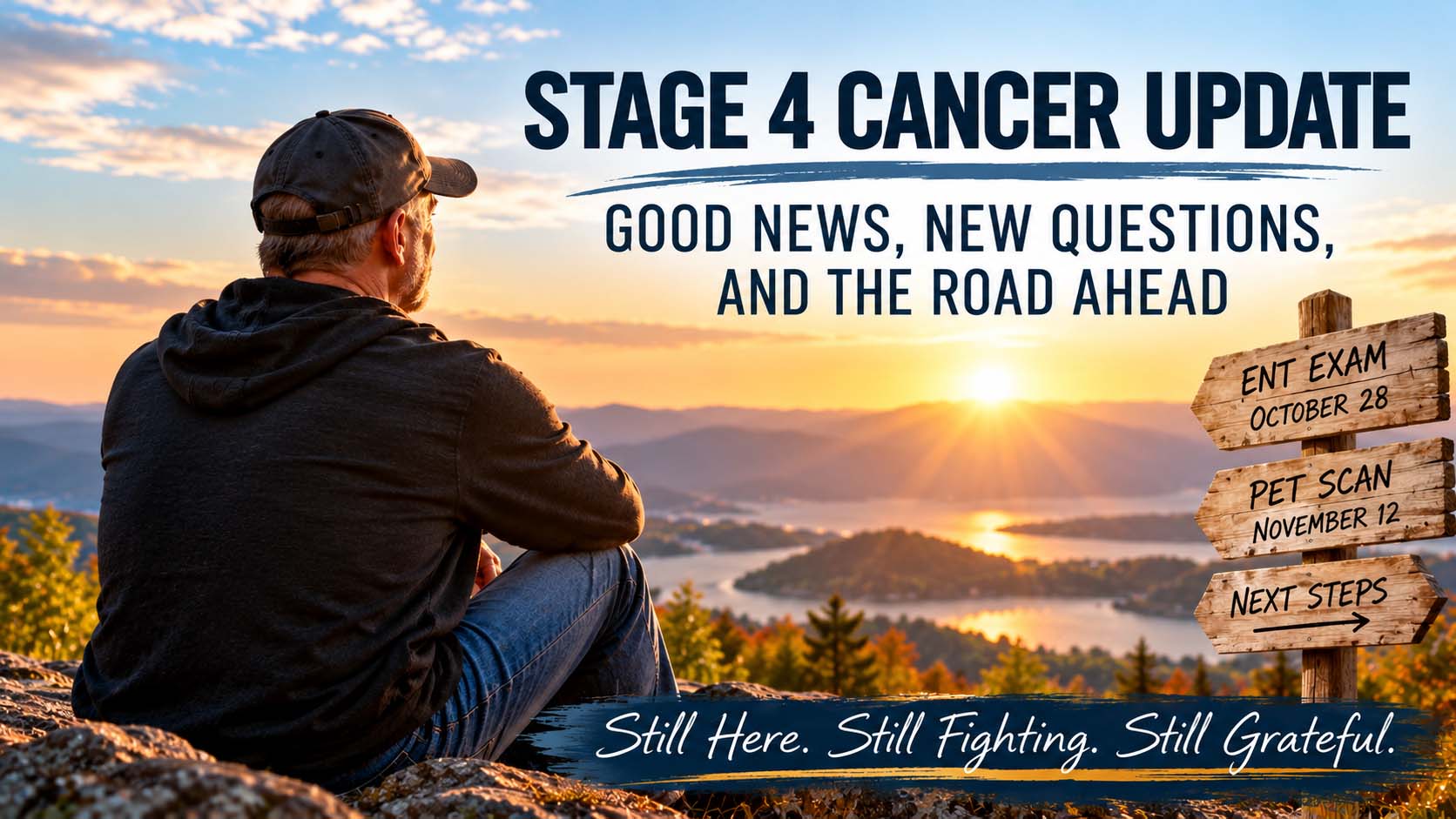
First, I Will Be Seeing an ENT Specialist on October 28
The ENT will closely examine the left side of my throat, where the CT scan identified abnormal tissue.
The goal is to determine whether this represents scar tissue, radiation-related changes, inflammation, or something more concerning.
Depending on what the specialist finds, additional testing or a biopsy may be necessary.
Second, I Have a PET Scan Scheduled for November 12
Unlike a regular CT scan, which primarily shows the size and structure of tissues, a PET scan looks for areas of increased metabolic activity.
This will help my medical team further evaluate the suspicious area in my throat, the enlarged lymph nodes in my chest, and the changes in my lungs.
Because inflammation can also increase activity on a PET scan, the results will need careful interpretation.
My hope is that these examinations will provide a clearer picture of my current cancer status.
Third, I Plan to Restart Several Components of My Integrative Cancer Treatment Approach
After everything I’ve been through, I’ve also made some important decisions about my future treatment options.
Having undergone 70 radiation treatments, I’ve already received an extensive amount of radiation, and I’ve been told that additional radiation to previously treated areas would carry significant risks.
I’ve also made the personal decision that I will not undergo another chemotherapy infusion.
After experiencing the physical toll of previous treatments, including lasting neuropathy, I’m not willing to put my body through that again.
These decisions make it especially important for me to carefully consider my remaining treatment options and take an active role in my health.
With that in mind, I plan to reintroduce ivermectin, fenbendazole (FenBen), and high-dose IV vitamin C, which were previously part of my integrative protocol.
I’m also tightening up my nutrition by significantly reducing my sugar and carbohydrate intake and returning to a more disciplined ketogenic approach.
My goal is to continue supporting my overall health while working with my oncology team to understand the latest findings and determine what comes next.
I’ve fought too hard and come too far to stop being proactive about my health.
How Am I Feeling?
One thing I want everyone to know is that I continue to focus on recovering from everything my body has been through.
After 70 radiation treatments, chemotherapy, surgery, and immunotherapy, there are lasting effects.
I continue to deal with stiffness and fibrosis in my neck, swallowing difficulties, and the effects of nerve damage.
Earlier this year, I also experienced significant problems with my voice.
Thankfully, my voice has improved considerably, and I’ve been working with speech and physical therapists to regain strength, mobility, and function.
Emotionally, I’m doing my best to stay positive.
I won’t pretend that seeing new suspicious findings on a scan doesn’t concern me. After fighting cancer for more than five years, you learn that even encouraging results can come with unexpected questions.
But I also know how far I’ve come.
There was a time when I could barely speak. Today, my voice has returned significantly.
There was a time when my lungs contained multiple cancerous nodules. Today, some of those nodules are no longer visible on my scans.
Those improvements remind me why I continue to have hope.
Recovery isn’t always quick, and some days are better than others.
But I continue moving forward.
Living With Scanxiety
One of the most difficult parts of living with Stage 4 cancer is the uncertainty between scans.
There’s even a name for it: scanxiety.
It’s the anxiety that comes before a scan, while waiting for the results, and sometimes after receiving findings that aren’t entirely clear.
This latest scan is a perfect example.
On one hand, I have encouraging evidence of improvement in my lungs.
On the other hand, there are new findings that need to be investigated.
You celebrate the victories while trying not to let the unanswered questions consume your thoughts.
Having experienced scanxiety many times throughout my cancer journey, I know firsthand how emotionally exhausting it can be. That’s why I wrote a separate article, What Is Scanxiety? Understanding the Anxiety of Cancer Scans, where I share my personal experiences, explain why scanxiety happens, and discuss ways to manage the uncertainty.
If you’re facing an upcoming cancer scan or waiting for results, I encourage you to read it:
I’ve learned that I cannot control every test result, but I can control how I respond to the uncertainty.
And I choose to keep living, keep fighting, and keep believing.
Faith, Family, and Gratitude
When I was diagnosed with Stage 4 cancer in June 2025, the outlook was frightening.
I remember those early conversations with my doctors and the uncertainty about how much time I might have.
Today, more than a year later, I’m still here.
I’ve experienced meaningful improvements in my scans, regained much of my voice, and continued rebuilding my strength.
None of that means the journey is over.
I know there are still challenges ahead, and I’m not declaring victory over cancer before the medical evidence supports it.
But I am grateful for how far I’ve come.
My faith continues to give me strength. My family gives me reasons to keep pushing forward.
And the prayers, messages, and encouragement from friends and supporters mean more than I can adequately express.
Still Here. Still Fighting. Still Grateful.
The next few weeks will bring more appointments, more tests, and hopefully more answers.
On October 28, I’ll meet with the ENT specialist. On November 12, I’ll undergo another PET scan.
Of course, I hope both examinations bring reassuring news. But whatever the results, I’m determined to face them with the same faith, perseverance, and support that have carried me this far.
When I received my Stage 4 diagnosis in June 2025, I didn’t know what the future would hold.
Sixteen months later, I’m still here, still making memories with my family, still working to rebuild my strength, and still sharing my story in the hope that it helps someone else facing a similar diagnosis.
Thank you to everyone who has prayed for me, encouraged me, checked in on my family, or simply taken the time to follow my journey.
Your support means more than words can express.
I’ll share another update when we have the results from my upcoming examinations.
When I published my memoir, Still Here, I thought I was telling the story of everything I had survived. But I’ve come to realize that my story is still being written. There are more chapters to live, more memories to make with the people I love, and more reasons to keep fighting. I don’t know what tomorrow holds, but I know I’m not finished living. And as long as God gives me another day, I’ll keep turning the pages.
Still Here. Still Fighting. Still Grateful.
Wayne
WaynesCancerJourney.com
Medical note: This is my personal account of my cancer treatment and recent imaging results. My medical team is still evaluating the findings discussed here. My experience should not be interpreted as medical advice or proof that any particular treatment caused my cancer to respond.
Read the blog at WaynesCancerJourney.com. Share the story with someone who needs it. Leave a review for my memoir, Still Here, on Amazon. Every action moves the mission forward.