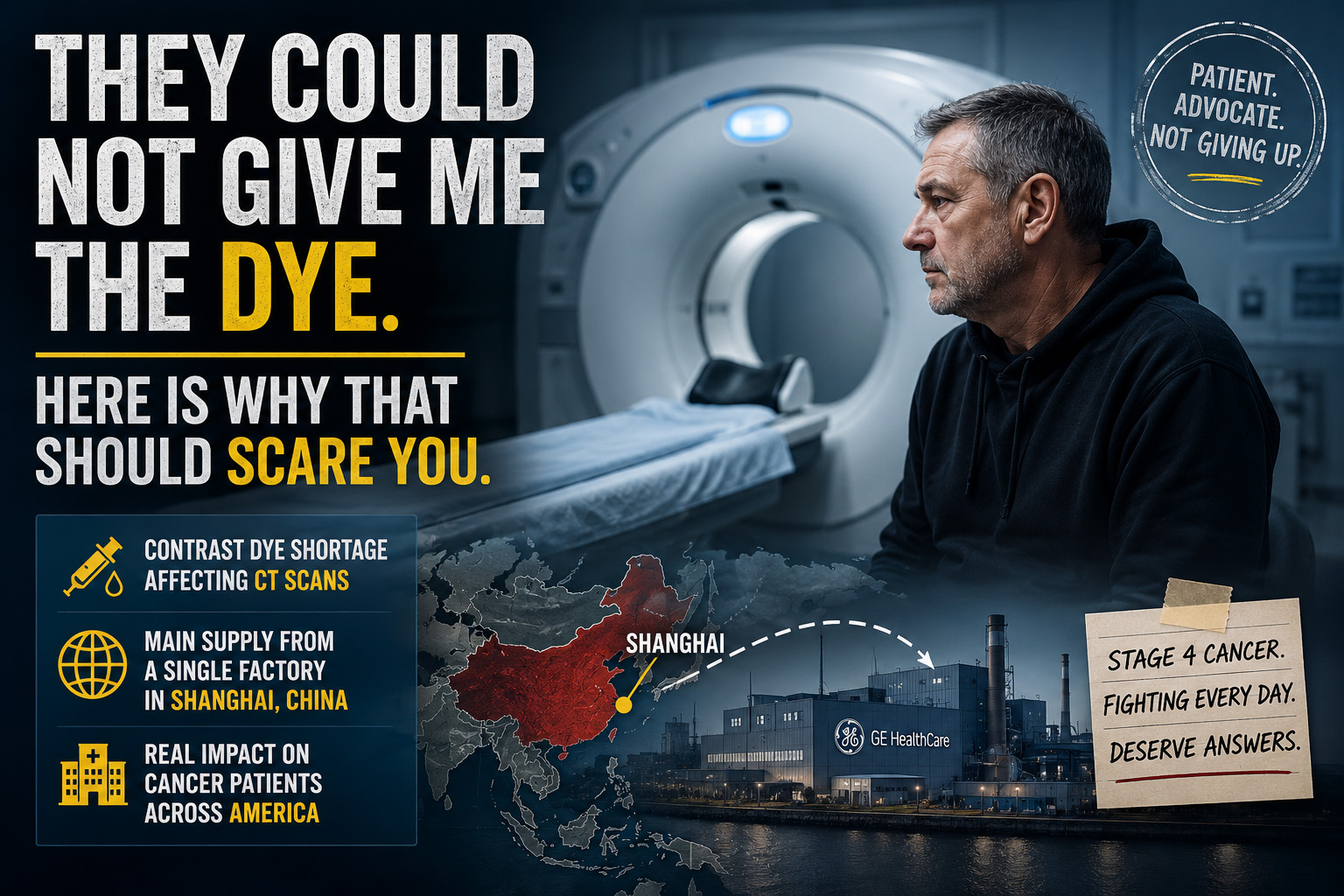
I have had so many CT scans over the past four years battling cancer that I have lost count.
You would think it gets easier. It does not. The night before, you lie there in the dark and your mind starts going. You replay every cough, every ache, every weird feeling you brushed off. You pray. You try to sleep. You mostly do not.
Then you go in. You lie still on that cold table. And you trust the machine to tell you the truth.
This time, the machine could not give me the full picture. And when I found out why, I had to write about it.
The CT Scan I Got Was Not the CT Scan I Needed
When you have stage four cancer, a CT scan is not just a picture. Before the scan, they inject a contrast dye into your vein. That dye lights up your blood vessels and tissue so the radiologist can see your tumors clearly, measure them precisely, and compare them to your last scan.
Without that dye, the picture gets murky. You can see something is there. You cannot always measure it well. For someone trying to know whether their cancer is growing or shrinking, that difference is everything.
According to a research letter published in JAMA, iodinated contrast dye is used in nearly half of all CT scans in the United States, and more than 54 million diagnostic imaging exams using contrast are conducted in this country every single year. [1] That is not a niche medical product. That is the backbone of how doctors see inside the human body.
Yesterday, my scan was done without contrast dye.
I was told at the last minute that there is a national shortage. My care team let me know. And when I got home and started reading, I found out this is not a local supply hiccup. It is a real, documented, recurring crisis. And every cancer patient in this country deserves to understand it.
Why Is There a Shortage? The Answer Is China.
The contrast dye used in CT scans is called iodinated contrast media. The two most common products are branded Omnipaque and Visipaque. Both are made by GE Healthcare.
Here is what I did not know until yesterday: GE Healthcare’s main production facility for this dye is in Shanghai, China. Not one of several plants. The main one. The facility that supplies a huge share of the entire world’s contrast media. [2]
This has been the arrangement for years. American hospitals, American cancer patients, American radiologists, all of us are depending on one factory in a foreign country to keep our imaging supply running. When something disrupts that factory, it hits every hospital in this country.
Roughly half of all United States hospitals use GE Healthcare as their primary contrast media vendor. [3] That is the level of dependence we have built on a single overseas manufacturer.
That is exactly what happened in 2022. A COVID lockdown shut the Shanghai plant down entirely. GE’s backup factory in Ireland could only cover about 20 percent of the normal supply. [2] Hospitals started rationing dye. Cancer patients had scans delayed or canceled. Stroke patients had fewer diagnostic tools available.
“It is probably one of the biggest risks for patient safety since COVID hit.” — Dr. Elliott Haut, Johns Hopkins Medicine [2]
Members of Congress wrote to the President. The FDA approved emergency imports of foreign-labeled contrast products from Europe to fill the gap. [4] Radiology departments scrambled. Patients waited.
Medical experts warned at the time that it would happen again. A September 2025 report in AuntMinnie noted that institutions need to take proactive measures because another shortage is likely. [5] We are here again.
I am 57 years old. I have stage four cancer. I have been through 70 radiation treatments, 20 chemotherapy infusions, and a five-hour radical neck dissection surgery with three surgeons. I take Keytruda immunotherapy. I do IV vitamin C infusions. I eat carnivore. I fight every single day to stay alive.
And I could not get the dye I needed for my scan because of a supply chain issue at a factory in Shanghai.
That is where we are.
“Whether this is originating in China with contrast media or in the United States with infant formula, supply chain redundancy is a critical lesson we are relearning the hard way.” — Dr. Matthew Davenport, University of Michigan Health / American College of Radiology [1]
What This Means for My Cancer Right Now
My April 7 scan confirmed no cancer progression. My nodules were stable. That was a good day. That scan had contrast dye.
Yesterday’s scan did not. The radiologist noted my nodules and lymph nodes as generally stable, but without contrast, precise measurement is not possible. The scan was focused on a separate problem we are tracking right now, whether my Keytruda immunotherapy is causing an immune reaction in my lungs, or whether I am dealing with recurrent aspiration pneumonia. Both are real possibilities that need to be sorted out.
So my official cancer status is still what it was on April 7. No progression. But I cannot get a properly measured, comparable scan until I can get contrast dye. And right now that is not guaranteed.
I have an appointment coming with my oncologist. I have questions. Can we prioritize a contrast CT? Is an MRI with a different contrast agent an option? MRI uses a different type of dye called gadolinium, which is not part of this shortage. [6] And we also need to discuss my lung inflammation and whether Keytruda needs to be temporarily paused.
That last one is a conversation I do not take lightly. Keytruda is part of why I am still here.
I will share what I learned.
We Should Not Be in This Position
I am not writing this to scare anyone. I am writing it because this is my blog and honesty is the only thing I know how to do here.
More than 54 million contrast imaging exams happen in the United States every year. [1] About half of all CT scans use this dye. We built a system that depends on one country, and in many cases one facility, to keep those numbers running. And when that facility has a problem, the ripple does not stay over there. It lands right here. On patients. On families. On a 57-year-old man lying on a CT table being told he cannot get the full scan he needs to monitor his stage four cancer.
GE Healthcare has since invested nearly $400 million over the past decade to expand its global manufacturing network, including a new $30 million production line in Ireland and an $80 million expansion in Norway. [7] That is good. It is not enough. It is not fast enough. And it does not help a cancer patient whose scan is happening right now.
There are only four companies in the entire United States that supply contrast media. [4] Four. For a product used in tens of millions of procedures every year. That is a fragile system by any measure.
This is not a political issue to me. It is a patient safety issue. Domestic manufacturing, supply chain backup plans, strategic reserves of critical medical supplies, these are not complicated ideas. They are common sense. And we keep having to relearn that lesson the hard way.
I will keep pushing my care team to get me what I need. I will keep showing up. I will keep telling you the truth about what it is actually like to navigate this fight.
I have said it before and I mean it every single time.
I am still here.
With faith and gratitude,
Wayne Schlicht
WaynesCancerJourney.com
Read the blog at WaynesCancerJourney.com. Share the story with someone who needs it. Leave a review for my memoir, Still Here, on Amazon. Every action moves the mission forward.
SOURCES
[1] Davenport MT, et al. “Comparison of Strategies to Conserve Iodinated Intravascular Contrast Media for Computed Tomography During a Shortage.” JAMA, June 9, 2022. Also cited in Michigan Medicine Health Lab, “Global Contrast Media Shortage: Strategies for Conservation,” 2022.
[2] Giddy.com, “Contrast Dye Shortage Continues Due to Supply Chain Issues.” References GE Healthcare Shanghai facility production data, Reuters reporting on Cork backup plant capacity, and Dr. Elliott Haut, Johns Hopkins Medicine.
[3] Michigan Medicine Health Lab, “Global Contrast Media Shortage: Strategies for Conservation.” University of Michigan Health, 2022.
[4] Imaging Technology News, “Contrast Media Supply Shortage: How and What Now?” November 2022. References FDA emergency import approvals and four-company US supply market.
[5] AuntMinnie, “Week in Review: Responding to Next CT Contrast Media Shortage.” September 6, 2025.
[6] Reeder SB, et al. “Magnetic Resonance Imaging as an Alternative to Contrast-Enhanced CT to Mitigate Iodinated Contrast Shortages.” Journal of Magnetic Resonance Imaging, June 2022.
[7] GE HealthCare, “Preventing Future Global Shortages of Iodinated Contrast Media Requires Industry Action.” GE HealthCare Insights, 2023.